


The Secret Teachings of Quetzalcoatl and the Overlap with Western Occultism
Spend enough time in esoteric, occult, or comparative mythology circles and a pattern becomes impossible to ignore.
Osiris dies and rises. Dionysus dies and rises. Prometheus steals fire from the gods and gives it to humanity at great personal cost. Odin hangs himself on the world tree to receive the runes - sacred knowledge - and survives transformed. Enki, the Sumerian god of wisdom, brings civilization to humanity from a realm beyond ordinary reach. Viracocha among the Inca, Kukulcan among the Maya, the Pahana of the Hopi - across cultures with no documented contact, the same figure keeps appearing.
He carries knowledge that transforms. He crosses the threshold between the living world and the realm of death. He descends, suffers, and returns. And before he goes, he leaves a transmission.
Carl Jung called the underlying structure an archetype - a pattern so fundamental to human consciousness that it surfaces independently wherever people ask the deepest questions about existence. Joseph Campbell mapped it across dozens of traditions. Neither was making a mystical claim. They were observing something structural: that human beings, across history and geography, keep reaching for the same figure to explain what wisdom costs and what transformation requires.
The list of deities that scholars, researchers, and occult traditions have placed in this cluster is long. But two expressions of this archetype dominate contemporary esoteric and new age discourse - and they point, through an unexpected chain of connections, directly to a valley in central Mexico.
The Two That Dominate Today
In modern spiritual and esoteric circles, two figures absorb more attention than any others.
The first is Jesus - or more precisely, the concept of Christ consciousness: the idea that Jesus represents not merely a historical person but a universal principle of divine wisdom incarnating into human experience, dying, and returning transformed. Whether approached devotionally, esoterically, or as pure archetype, this pattern has shaped Western spiritual thought for two millennia and shows no sign of fading.
The second is Hermes Trismegistus - the source of the Hermetic Principles, the grandfather of Western alchemy, Rosicrucianism, Freemasonry, and most of what the modern new age tradition draws from. The Kybalion alone has introduced millions of people to the seven principles: Mentalism, Correspondence, Vibration, Polarity, Rhythm, Cause and Effect, Gender. For anyone who has spent time in these circles, the Hermetic framework is foundational.
These two figures, Jesus and Hermes Trismegistus, are more connected than most people realize.
Jesus and Hermes Trismegistus
Hermes Trismegistus emerged from one of the most remarkable moments of cultural fusion in ancient history. When Greek and Egyptian civilizations collided in the Hellenistic period following Alexander's conquest of Egypt in 332 BCE, scholars and priests from both traditions looked at their respective figures - the Greek Hermes, messenger and psychopomp, god of language and sacred knowledge, and the Egyptian Thoth, inventor of writing, guide of souls through the underworld - and recognized them as the same being. Hermes Trismegistus, Thrice-Greatest Hermes, was the result: a merged figure understood as the embodiment of divine wisdom itself.
The early Christian world took this seriously. Church fathers including Lactantius explicitly engaged with the Hermetic texts, debating whether Hermes Trismegistus was a pagan prophet who had foreseen the coming of Christ. The opening of the Gospel of John - "In the beginning was the Word" - draws on the same Logos concept that sits at the center of Hermetic philosophy: the idea that divine reality expresses itself as an organizing intelligence, and that to understand this is to understand the structure of existence. Justin Martyr noted the parallels between the two traditions. The Church didn't dismiss Hermes Trismegistus - it argued about him, which is a different thing entirely.
The connection between Jesus and the Hermetic tradition is not a modern new age invention. It was a live debate among serious thinkers in the first centuries of the common era, and it has never been fully resolved - because the structural resemblances are real.
Quetzalcoatl
Which brings us to a figure most Western esoteric practitioners have underestimated.
Quetzalcoatl - the Feathered Serpent of Mesoamerica, venerated across Aztec, Toltec, and Maya traditions - has no historical connection to ancient Egypt or Greece. The Americas and the Mediterranean did not share texts. No diffusion argument explains what follows. And yet.
He is the patron of priests, the inventor of the sacred calendar and books, and the bringer of agricultural and civilizational knowledge to humanity - functions that map precisely onto Thoth as the originator of writing and Hermes as the god of language and sacred philosophy. He descends to Mictlan, the realm of the dead, to retrieve the bones of a previous humanity, and anoints them with his own blood to create the people of the current age - knowledge and self-sacrifice fused into a single act of creation. He is driven from his kingdom, burns himself on a pyre, and rises as Venus, the morning star.
The Spanish missionaries who first documented these details were disturbed enough to record them carefully. The resemblances to the Christ story - the unusual conception, the peaceful and priestly nature, the self-sacrifice, the resurrection as the morning star, the promise of return - were noted in colonial-era sources and have been analyzed by researchers ever since. Diane Wirth formally compared the sacrificial-creation pattern in Quetzalcoatl's myth to Christ's redemptive self-sacrifice in the Journal of Book of Mormon Studies. Carlos Fuentes, one of Mexico's most celebrated writers, placed Quetzalcoatl in direct literary comparison with Prometheus and Moses. The Book of Revelation calls Jesus "the bright morning star." Quetzalcoatl rises as Venus, the morning star. Both primary texts say this plainly.
No serious researcher has claimed Quetzalcoatl and Hermes Trismegistus are historically connected — because they aren't. But the same archetype that produced Hermes-Thoth in the Mediterranean, and that early Christian thinkers saw reflected in Jesus, appears fully formed in Mesoamerica in Quetzalcoatl: the wisdom bringer, the psychopomp, the one who descends and returns transformed, the figure whose sacrifice creates rather than merely ends.
If the Hermetic Principles describe what this archetype actually teaches - stripped of any single culture's language - then Quetzalcoatl is not outside that tradition. He is one of its most complete expressions.
But to understand why, it helps to look at who was actually doing the understanding.
The Priests Who Knew
Every major esoteric tradition draws the same distinction: the outer teaching for the general population, and the inner teaching for those trained to receive it. Christianity has its exoteric church and its Gnostic and mystical currents. The Hermetic tradition was itself the inner teaching of the ancient world - preserved in mystery schools, passed through initiatory lineages, encoded in symbol and myth precisely because it was not meant for everyone.
The Quetzalcoatl tradition was no different.
The people most devoted to Quetzalcoatl were the tlamatinime - a Nahuatl word that translates roughly as "those who know something," or philosophers. These were the priest-scholars trained in the calmecac, the elite school where future astronomers, poets, judges, and ritual specialists were educated. The calmecac was notoriously austere. Entry was not a matter of birth alone. The curriculum was rigorous: astronomy, calendar science, rhetoric, dream interpretation, sacred history, and the cultivation of inner discipline. Quetzalcoatl was the patron of this institution. He was, in the most direct sense, the god of the initiated.
What the tlamatinime actually believed, beneath the cosmological mythology, maps with striking precision onto the inner teachings of both the Hermetic tradition and the mystical currents within Christianity.
They held that ordinary perception does not access reality. They had a specific concept for this - neltiliztli, meaning "rootedness" or "truth" - and they debated seriously whether stable knowledge of reality was accessible to human beings at all. This is not folk religion. It is epistemology. It is the same question the Hermetic tradition answers with the Principle of Mentalism: that the universe is fundamentally mental, and that what most people experience as reality is a function of their current level of understanding, not a fixed external fact. It is the same question the Gnostic traditions answer with the concept of the veil - that ordinary consciousness is a kind of sleep, and that gnosis is the awakening from it.
They believed the human being mirrored the cosmos - that the patterns of celestial movement were the patterns of inner life, and that to understand one was to understand the other. This is the Principle of Correspondence stated in Nahuatl terms, developed independently, applied through the sacred calendar that Quetzalcoatl himself gave them.
They understood the soul as multiple and composite - tonalli, teyolia, ihiyotl - three distinct animating principles requiring integration. The work of the priestly life was the cultivation and alignment of these inner forces. This is not distant from the Hermetic understanding of the human being as a microcosm containing all the principles of the macrocosm, requiring inner work to bring into coherence.
And they held that the closest approach to truth available to human beings came through in xochitl in cuicatl - "flower and song" - poetry and sacred art as the medium through which the divine could be touched. Reason alone could not reach it. Beauty, symbol, and ritual were necessary. This is the same understanding that generated the Hermetic tradition's rich use of allegory, the Kabbalistic use of sacred geometry, the Sufi use of poetry - the recognition that some knowledge cannot be transmitted propositionally, only evoked.
Miguel León-Portilla, the foremost scholar of Nahua philosophy, spent his career arguing that the tlamatinime were not primitive cosmologists but genuine philosophers engaged with the same foundational questions as the pre-Socratic Greeks. His landmark work Aztec Thought and Culture reconstructed their intellectual tradition from surviving poetry, the Florentine Codex, and Nahuatl oral sources - fragments of a tradition that was largely destroyed when the Spanish burned the books.
That last fact matters. We are working from ruins. What survived is enough to recognize the tradition for what it was. What was lost is almost certainly more than what remains.
Two Traditions, One Map
This is where it becomes worth setting the two frameworks side by side, not to claim they are the same system, but to let the parallel speak for itself.
The seven Hermetic Principles, as codified in The Kybalion:
Mentalism: the universe is fundamentally mental; consciousness is primary.
Correspondence: as above, so below; as within, so without.
Vibration: nothing rests; everything moves; everything vibrates.
Polarity: everything is dual; opposites are the same thing at different intensities.
Rhythm: everything flows in and out; everything has its tides and cycles.
Cause and Effect: every cause has its effect; chance is a name for unrecognized law.
Gender: masculine and feminine exist in everything; creation requires both the receptive and the generative.
What the Quetzalcoatl-oriented priest class, the tlamatinime, appears to have held - reconstructed by scholar Miguel León-Portilla in Aztec Thought and Culture from surviving Nahuatl poetry, the Florentine Codex compiled by Sahagún, and oral tradition:
That reality has a deeper structure than ordinary perception reveals. That this structure is accessible through disciplined study, ritual, and cultivated awareness. That the human being is a microcosm of the larger cosmic order. That time is cyclical, not linear, and that understanding the cycles is the foundation of wise action. That self-knowledge and self-discipline are prerequisites for any real understanding - the calmecac training was notoriously austere. That the cosmos requires human participation to continue, and that this participation is not servitude but a form of co-creation.
These were not the beliefs of the general population, who engaged with the outer mythology as most people in any tradition engage with theirs - literally, ritually, culturally. The tlamatinime held the inner teaching, as the Hermetic schools held theirs, as the Gnostics held theirs, as the Kabbalists, the Sufis, the Neoplatonists, and the initiatory brotherhoods of every major civilization held theirs. The pattern is consistent across history: an outer layer accessible to everyone, and an inner teaching preserved by those trained to receive it, transmitted through rigorous study and direct experience rather than doctrine.
What León-Portilla established, and what makes his work significant beyond academic Nahuatl studies, is that the tlamatinime were doing philosophy in the fullest sense. They were asking the same foundational questions as the pre-Socratic Greeks, arriving at structurally similar answers, through a completely independent tradition. The calmecac was a mystery school. Quetzalcoatl was its patron deity. And the inner teaching it transmitted maps, with remarkable consistency, onto the principles that Hermes Trismegistus left to the West.
Why Tepoztlán
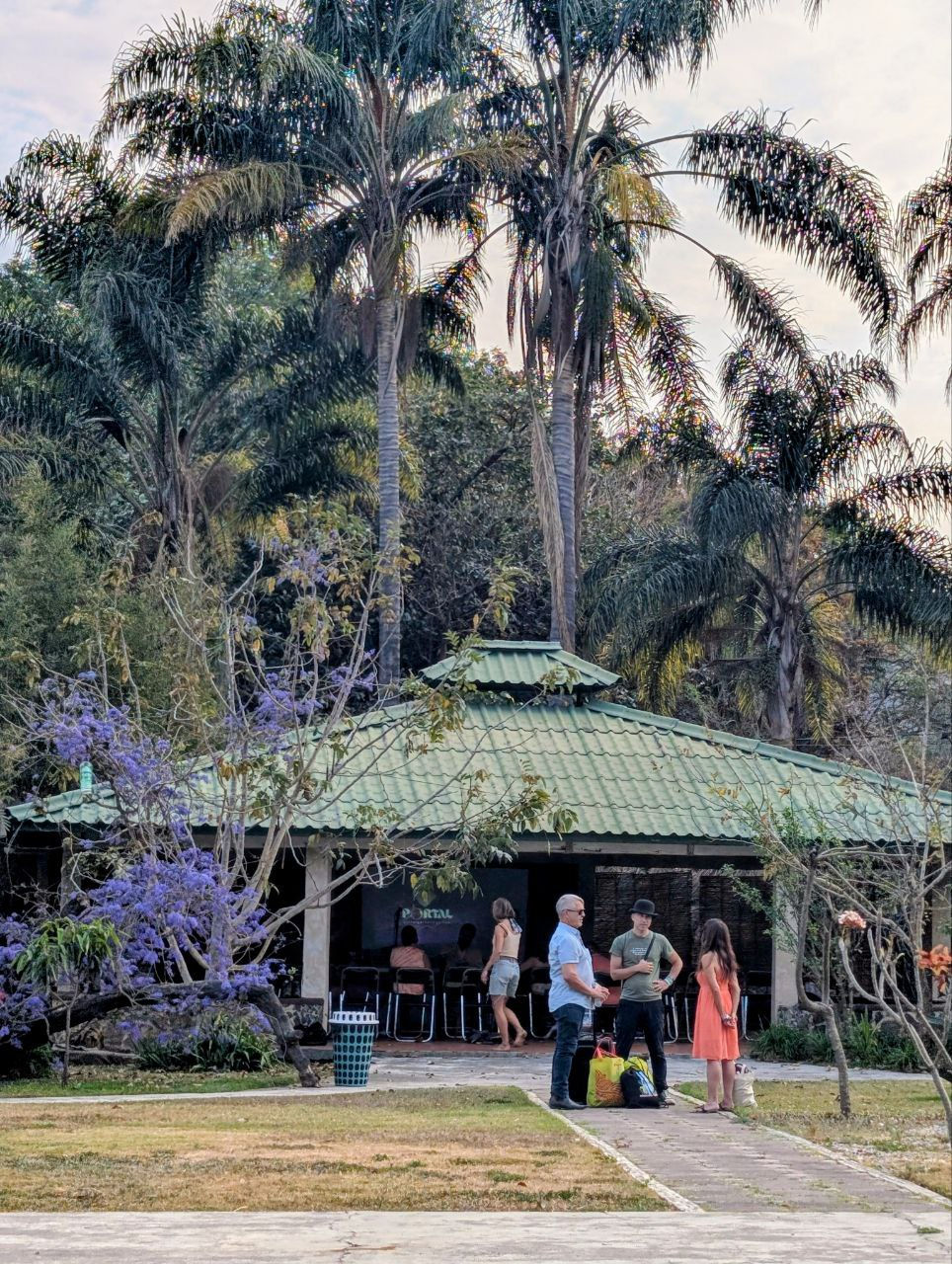
Tepoztlán has a reputation that precedes it. Among seekers, mystics, and alternative researchers it is known as one of the most energetically charged places in the Americas - an area of unusual electromagnetic activity, a valley whose toroidal geography is theorized to function as a natural vortex. It is the most reported location for UFO sightings in Mexico. More practically, it has been a destination for healers, shamans, artists, and spiritual practitioners for generations - the kind of place people find their way to when ordinary life stops being sufficient. That is not incidental to why Portal Gatherings is here. It is the reason.
Portal Gatherings organizes hikes to two sites in this valley as part of every gathering.
The first is the pyramid of Tepozteco - perched on the mountain above the town, accessible only on foot, looking out over a valley ringed by peaks in every direction. It is dedicated to Tepoztecatl, a deity of this region sometimes equated with Quetzalcoatl or understood as a regional expression of the same force. The hike alone strips something away. The view from the top - the valley below, the mountains enclosing it, the sky unobstructed - does something else. Whatever you believe about the mythology, you are standing on ground that has been understood as sacred for centuries, that has drawn pilgrims continuously, that carries the accumulated intention of everyone who climbed it before you. That is not nothing.
The second is the Pozas de Quetzalcoatl in Amatlán, traditionally held to be the birthplace of Ce Acatl Topiltzin Quetzalcoatl, the historical priest-king whose life and legend became inseparable from the god whose name he carried. This is where, according to tradition, the figure at the center of this entire lineage entered the world. Whether you read that as the birthplace of a man, a myth, or an idea whose time had come, the place carries a quality that consistently surprises people who visit it without expectation.
Portal Tepoztlán is a gathering of people pursuing direct contact with the deeper structure of reality, in community, in a place that supports that work. Seekers of hidden knowledge, pursuers of truth and freedom, learning from each other and integrating the lessons.
Every tradition covered in this blog arrived at the same inner teaching through a different door. The outer mythology differs. The questions are identical. And the questions have been alive in this valley for a very long time.
The Invitation
Whether you are deep in the study of occultism or are just beginning your journey with the law of attraction - this is an invitation to integrate and embody those understandings.
Portal Gatherings exists at the intersection of esoteric wisdom, personal sovereignty, and the understanding that reality responds to consciousness. We gather once a year in one of the most energetically charged valleys on Earth - to learn from each other, to do the inner work, and to remember what freedom actually feels like.
The conversations, the speakers, the community, the excursions into these mountains. It all points in the same direction.
Inward. And through.
Come to Tepoztlán. Step through the Portal.
Portal Gatherings takes place annually in Tepoztlán, Morelos, Mexico.


Comments